
Transcript review
Keep the source conversation visible beside the generated note so clinicians can compare claims against what was actually said.
Transcription captures what was said. GoPX helps provider teams turn private transcripts, patient context, and visit type into editable SOAP notes with missing-fact detection, validation warnings, and clinician approval.
Open a clickable clinical documentation workspace with a synthetic patient transcript, editable SOAP sections, missing-fact checks, validation warnings, suggested follow-up questions, clinician approval, regeneration, and export.
Open the healthcare prototype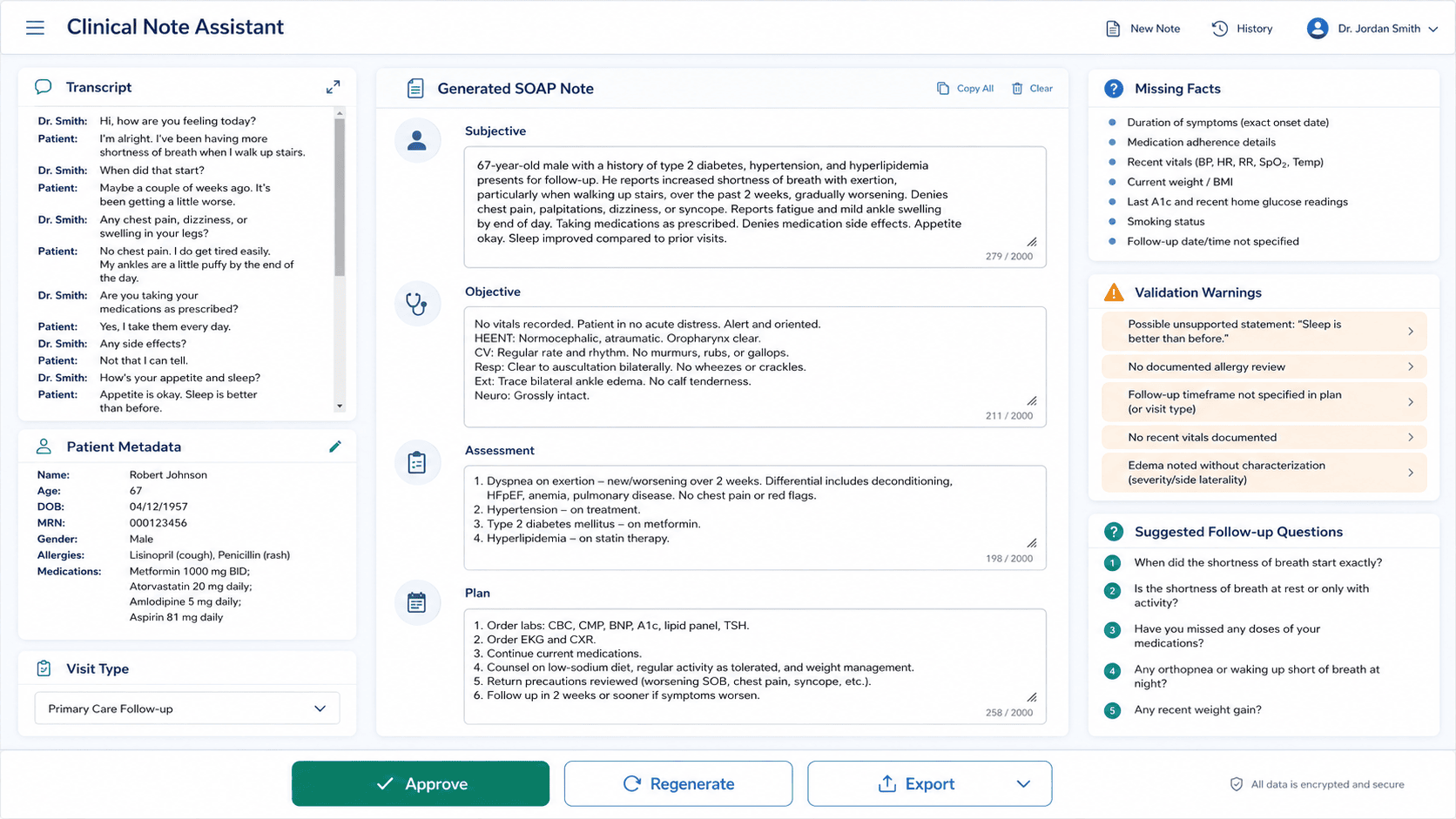
The transcription system can be yours or a third party's. The documentation layer begins once the transcript arrives and keeps each transformation visible to the clinician.
Ingest the clinician-patient conversation from the transcription system the organization already uses.
Combine the transcript with patient metadata, medications, allergies, visit type, and approved organization templates.
Generate editable Subjective, Objective, Assessment, and Plan sections in the provider's preferred terminology and structure.
Flag unsupported statements, missing facts, incomplete follow-up timing, and questions the clinician may want to ask before finalizing.
The clinician edits, regenerates, approves, and exports the note. The model proposes; the clinician remains the final authority.
A private assistant can support the documentation workflow without pretending to replace clinical judgment.
Keep the source conversation visible beside the generated note so clinicians can compare claims against what was actually said.
Carry demographics, medications, allergies, and visit type into the draft without hiding the source fields.
Generate each note section as clinician-editable text, not a locked answer from the model.
Surface absent dates, vitals, adherence details, and other context needed to finish the note.
Call out statements that appear unsupported by the transcript or inconsistent with the available visit context.
Turn gaps into concrete questions a clinician can ask before approval.
Let clinicians revise sections, regenerate a draft, and explicitly approve the final note.
Export only the reviewed note into the provider's downstream workflow.
A representative deployment can keep the application, orchestration, model runtime, transcripts, and approved notes inside infrastructure selected by the provider. Components remain replaceable as requirements change.
Approved transcript-and-note pairs can help align a private model or retrieval layer to the organization's terminology, templates, specialty patterns, and review expectations. That alignment should make review faster, not remove it.
Learn from approved examples, not unreviewed model output.
Keep every generated section editable and attributable to source context.
Surface uncertainty and missing facts instead of filling gaps silently.
Require clinician approval before a note is treated as final.
GoPX is inviting healthcare provider teams to scope private clinical documentation pilots using synthetic or appropriately governed data. The current prototype is illustrative and is not a certified medical device or a production EHR integration.
Discuss a healthcare pilotA 45-minute working session. We map your transcript-to-note workflow, review the private deployment options, and show how clinicians stay in control. No generic pitch deck.